
También disponible en español.
Background
 For several years, El Paso County Transit Services, now rebranded as El Paso Transportation Authority (ETA), has sought to expand and enhance transportation services for all in El Paso County beyond the City of El Paso transit provider’s (Sun Metro) service area. This has included operating fixed-route services (ETA Transit) and Americans with Disabilities (ADA) complementary paratransit and premium service (ETA Access).
With the goal of expanding the reach of public transit in unserved parts of the County (i.e., beyond the service areas of ETA Transit and Access and beyond Sun Metro’s service area), ETA has retained the Texas A&M Transportation Institute (TTI) to explore the need for and feasibility of implementing a community demand response transportation (DRT) service — or a network of different types of DRT services – to address this need.
Study Area
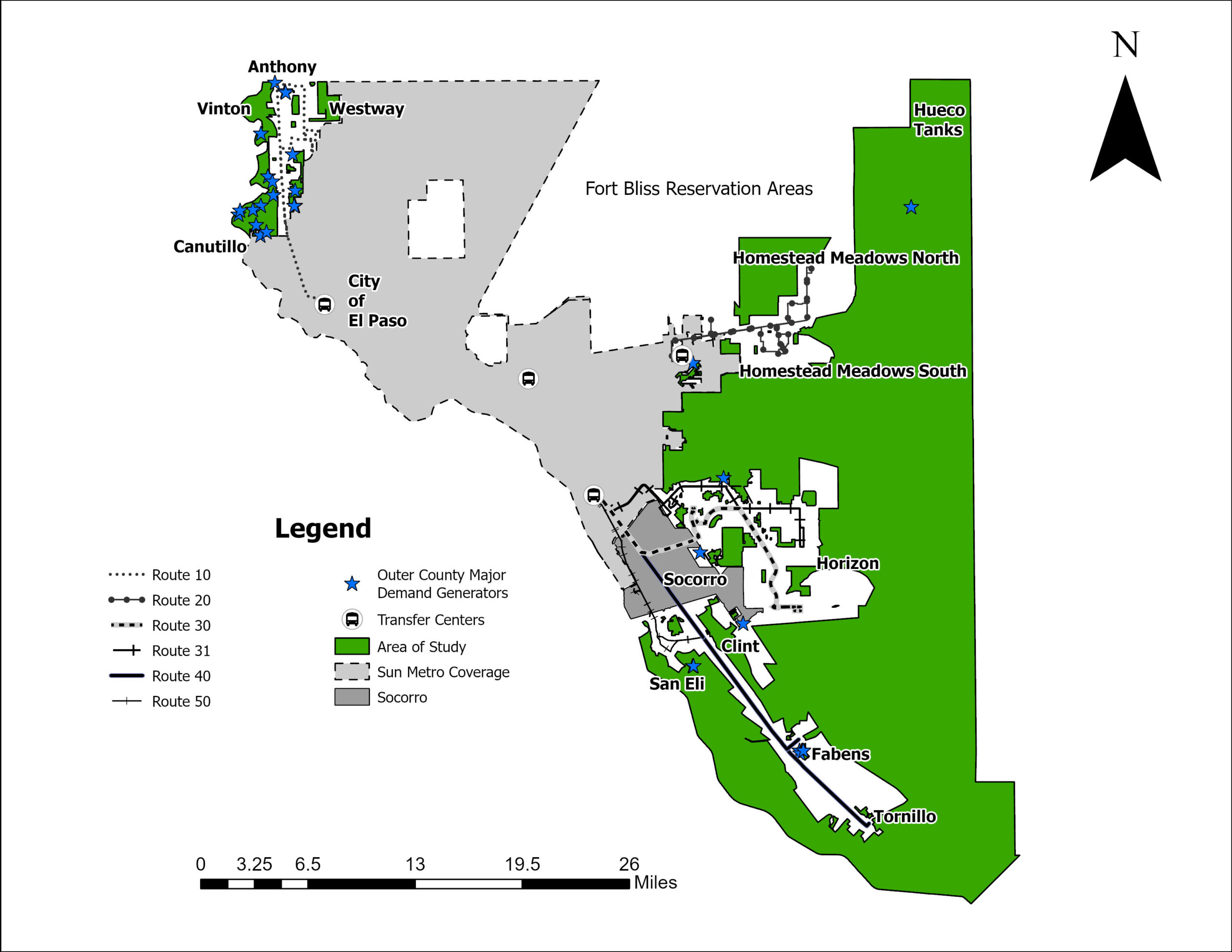
Below is a map of the DRT study area.
Useful Information
General Guidelines for County Transit Service
- County transit service should be available to all residents of rural El Paso County. County transit service can take the form of flexible bus routes or DRT service.
- New or modified County transit services should serve existing riders to the extent possible.
- County transit service should run at least 14 hours per day on weekdays and at least 12 hours per day on weekends.
- County transit service should not compete for riders with Sun Metro bus service.
Description of Service Types
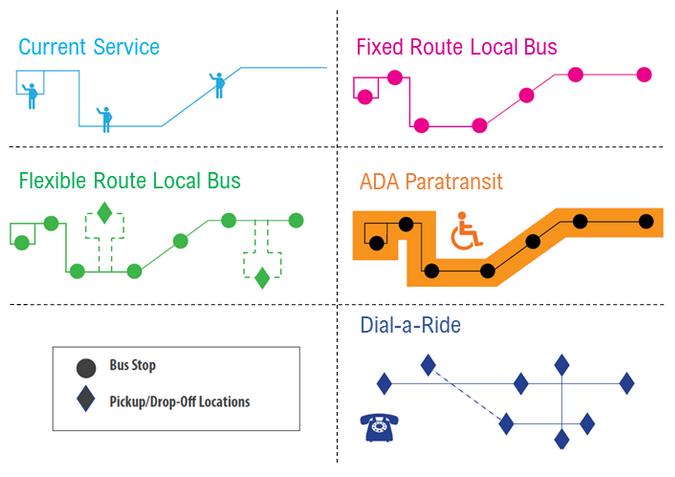
Current Service: A bus operates along established routes with set schedules, and passengers can get on and off the bus by flagging the bus driver. This is the service that existed prior to 2025.
Fixed-Route Local Bus: A bus operates along an established route with a set schedule, and passengers get on and off the bus only at marked stops. ADA Paratransit service is provided to areas within ¾ mile of the route.
Flexible Route Local Bus: A bus operates along an established route with a set schedule, and passengers get on and off the bus at marked stops. If requested in advance, the bus may flex, or leave the established route to travel to places within ¾ mile of the route.
ADA Paratransit: A small bus provides service to individuals with disabilities, according to the ADA, who call ahead and schedule a pickup. ADA paratransit service is provided to areas within ¾ mile of fixed routes.
Local Bus: A bus operates along an established route and serves local trips (i.e., trips that do not include other parts of the region).
Dial-a-Ride: A small bus provides service to passengers who call ahead and schedule a pickup. Dial-a-Ride service does not follow an established route but provides rides within a community or zone. Passengers who want to travel between zones transfer at existing transfer centers.
Transit Service Terms

Hours of service: How long a transit service or route operates on a particular day. For example, a bus route’s hours of service on weekdays (Monday through Friday) may be from 6:00 a.m. to 8:00 p.m.
Peak: The times of day when more people travel and sometimes more transit service is provided. Fo example, peak time periods might be 6:00 a.m. to 9:00 a.m. and 3:00 p.m. to 7:00 p.m.
Off-peak: The times of day when travel is lower than peak and sometimes less transit service is provided. Off-peak time periods are all the hours of service that are not in the peak time periods.
Frequency: How often a bus arrives on a route. For example, a bus may come once per hour. Increases in frequency mean that buses will come more often, and passengers will wait less time for a bus to arrive. Decreases in frequency mean that buses will come less often, and passengers will have to wait longer for a bus to arrive.
Preliminary Alternatives
We have developed and evaluated four preliminary alternatives for GPDRT in the county. Read about them in the booklet linked below. Then go to the “Your Feedback” section of this web page and let us know what you think about the preliminary alternatives.
Transit Study-booklet – 2025-v3 HR
Your Feedback
A major part of the effort includes hearing from you! We want to know what you think about the preliminary alternatives. We encourage you to complete our online survey and/or send an email with your comments to [email protected]. You can also go to the survey by clicking the button below.

We welcome your feedback as we work to provide a County transit system that meets the needs of everyone in the county!